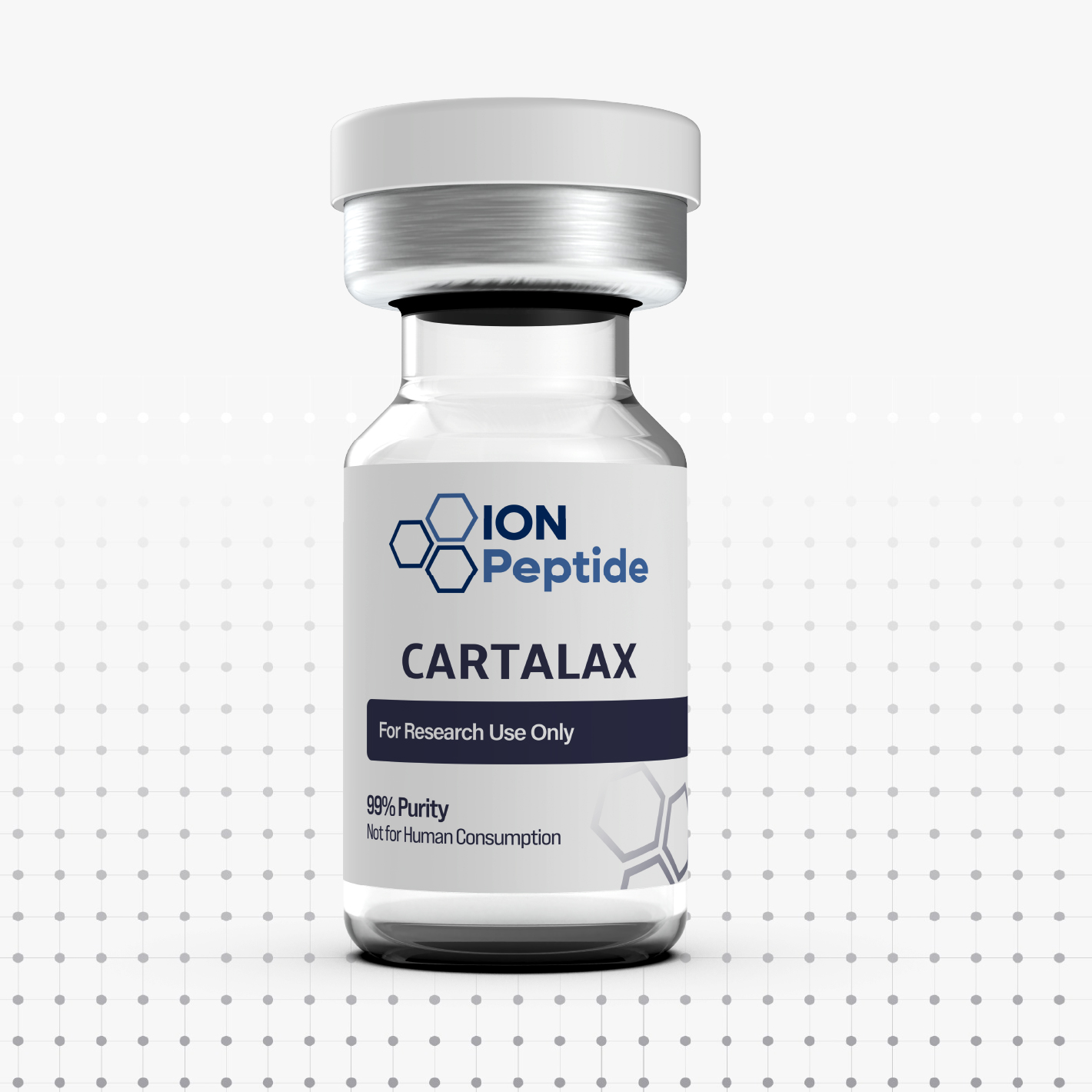


Buy Cartalax 20mg Online
Buy Cartalax 20mg Online. The field of peptide science has expanded significantly over the last several decades, leading researchers to investigate a wide range of naturally occurring and synthetic peptides that may help explain complex biological processes. Among the compounds attracting attention in tissue-specific peptide research is Cartalax 20mg, a synthetic peptide bioregulator that has been explored in studies involving cartilage biology, cellular communication, and connective tissue research.
Cartalax belongs to a group of compounds commonly referred to as Khavinson peptides or short peptide bioregulators. These peptides were developed within research programs focused on understanding how small amino acid sequences interact with cellular signalling pathways and gene expression. Although much of the research remains preclinical and has not been widely replicated internationally, Cartalax continues to generate interest among scientists studying cartilage and connective tissue biology.
This educational article explores the science behind Cartalax 20mg, its molecular characteristics, areas of scientific investigation, and why peptide researchers continue to study this unique compound.
What Is Cartalax?
Cartalax is a synthetic tripeptide bioregulator composed of three amino acids:
- Alanine
- Glutamic acid
- Aspartic acid
Its sequence is commonly written as:
Ala-Glu-Asp (AED)
The peptide was developed as part of research programs investigating short tissue-specific peptides and their potential interactions with biological systems. Researchers have examined Cartalax primarily in studies involving:
- Cartilage biology
- Connective tissue research
- Chondrocyte signaling
- Extracellular matrix studies
- Cellular ageing research
Cartalax is often classified as a cartilage-targeted bioregulator peptide, although many of its proposed mechanisms remain under investigation and require further validation.
Understanding Bioregulatory Peptides
Bioregulatory peptides are short amino acid sequences that researchers study because of their potential involvement in cellular communication and gene regulation.
Scientists investigate these compounds because they may provide insights into:
- Molecular signaling
- Cellular organization
- Protein interactions
- Tissue-specific regulation
- Biological maintenance systems
The Khavinson peptide research program introduced several tissue-specific peptides, including Cartalax, to explore how short peptides may influence complex biological pathways.
The Molecular Structure of Cartalax
The molecular characteristics of a peptide often determine how it behaves in laboratory models.
Researchers investigate several properties of Cartalax:
Amino Acid Composition
The peptide contains three amino acids arranged in a precise sequence.
Molecular Formula
C12H19N3O8
Molecular Weight
Approximately 333.29 g/mol.
Structural Stability
Scientists examine how the peptide behaves under different experimental conditions.
Biological Interactions
Researchers continue to investigate potential relationships between Cartalax and cellular signalling pathways.
Why Researchers Study Cartalax
Cartalax has become an area of interest because it provides opportunities to investigate several aspects of biology.
Cartilage Biology
Understanding the molecular characteristics of cartilage tissues.
Cellular Communication
Studying how cells coordinate signalling activities.
Connective Tissue Research
Investigating extracellular matrix organisation.
Molecular Regulation
Exploring interactions between peptides and cellular pathways.
Aging Research
Examining how tissues change over time in experimental models.
The peptide’s tissue-specific focus has made it an intriguing subject in peptide science.
Cartilage and Cartilage Research
Cartilage is a specialised connective tissue that performs important structural functions within the body.
Researchers study cartilage because it possesses unique characteristics, including:
- Limited regenerative capacity
- Complex extracellular matrix organization
- Specialised cellular populations
- Distinct protein composition
Cartilage laxity has been investigated in studies involving cartilage cell models and connective tissue biology because researchers are interested in understanding how small peptides may interact with these systems.
Chondrocytes and Cellular Biology
Chondrocytes are the primary cells found within cartilage tissue.
Scientists investigate these cells because they play important roles in:
- Matrix production
- Tissue organization
- Cellular signaling
- Protein synthesis
- Structural maintenance
Some experimental studies involving Cartalax have explored how short peptide bioregulators may influence cellular behaviour in cartilage-related models. However, many proposed mechanisms remain preliminary and require additional study.
Peptides and Cellular Communication
Peptides are short chains of amino acids that often function as signalling molecules.
Researchers study peptides because they participate in:
- Cellular communication
- Molecular signaling
- Protein interactions
- Biological coordination
- Physiological regulation
The ability of peptides to influence signalling pathways has made them valuable tools in biotechnology and molecular biology research.
Cartalax represents one example of how synthetic peptides can be used to investigate tissue-specific biological questions.
Applications in Scientific Research
Cartalax has been investigated across several scientific disciplines.
Molecular Biology
Studying peptide signalling and cellular interactions.
Connective Tissue Research
Examining extracellular matrix organisation.
Biochemistry
Understanding molecular mechanisms and protein behaviour.
Biotechnology
Developing advanced research tools and analytical methods.
Systems Biology
Investigating interactions among complex biological networks.
These areas continue to expand as scientific knowledge advances.
Laboratory Technologies Used to Study Cartalax
Modern peptide science relies on sophisticated analytical methods.
High-Performance Liquid Chromatography (HPLC)
Used to evaluate purity and composition.
Mass Spectrometry
Provides molecular identification and characterisation.
Computational Modeling
Predicts molecular interactions and structural behaviour.
Cell Culture Studies
Investigates peptide interactions with cellular systems.
Protein Analysis Techniques
Examines relationships between peptides and biological pathways.
These technologies have significantly improved scientific understanding of peptide compounds.
The Importance of Quality Standards
Reliable scientific investigations depend on rigorous quality control procedures.
Researchers commonly evaluate:
Purity
Ensuring reproducible experimental conditions.
Identity Verification
Confirming molecular composition.
Stability
Assessing storage characteristics and consistency.
Documentation
Supporting scientific integrity and transparency.
Reproducibility
Maintaining reliable laboratory standards.
Quality assurance remains essential for meaningful peptide research.
Storage and Laboratory Handling
Proper handling procedures are important in research environments.
General recommendations often include:
- Following supplier instructions
- Maintaining recommended storage conditions
- Preventing contamination
- Using validated laboratory techniques
- Monitoring material stability
Researchers should always follow institutional guidelines and established laboratory protocols.
Future Directions in Cartalax Research
Scientific interest in tissue-specific peptides continues to grow.
Future investigations may focus on:
Advanced Cartilage Biology
Understanding increasingly complex signalling networks.
Systems Biology
Investigating interactions among multiple pathways.
Protein Engineering
Developing new approaches to peptide design.
Computational Research
Modelling peptide interactions and biological behaviour.
Biotechnology Innovation
Creating improved analytical methods and research technologies.
As scientific understanding evolves, researchers are expected to continue exploring the role of short peptide bioregulators in cellular biology.
Why Peptide Research Matters
Peptide science has become an essential component of modern biotechnology.
Researchers increasingly recognise peptides as valuable tools for studying:
- Cellular communication
- Molecular signaling
- Protein interactions
- Tissue biology
- Complex physiological systems
The continued interest in Cartalax reflects the expanding importance of peptide science in understanding the mechanisms that regulate biological function.
Conclusion
Cartalax 20mg remains an intriguing subject in peptide research because of its relationship to cartilage biology and tissue-specific signalling pathways. As a synthetic tripeptide bioregulator, it continues to provide researchers with opportunities to investigate cellular communication, extracellular matrix organisation, and molecular regulation.
Although many questions remain regarding its mechanisms and broader applications, Cartalax contributes to ongoing scientific discussions surrounding peptide biology and connective tissue research.
For additional information about peptide-related research topics:
Website: https://ionpeptides.store/
WhatsApp: +1 (318) 341-5522
Email: support@ionpeptides.online
Related products